
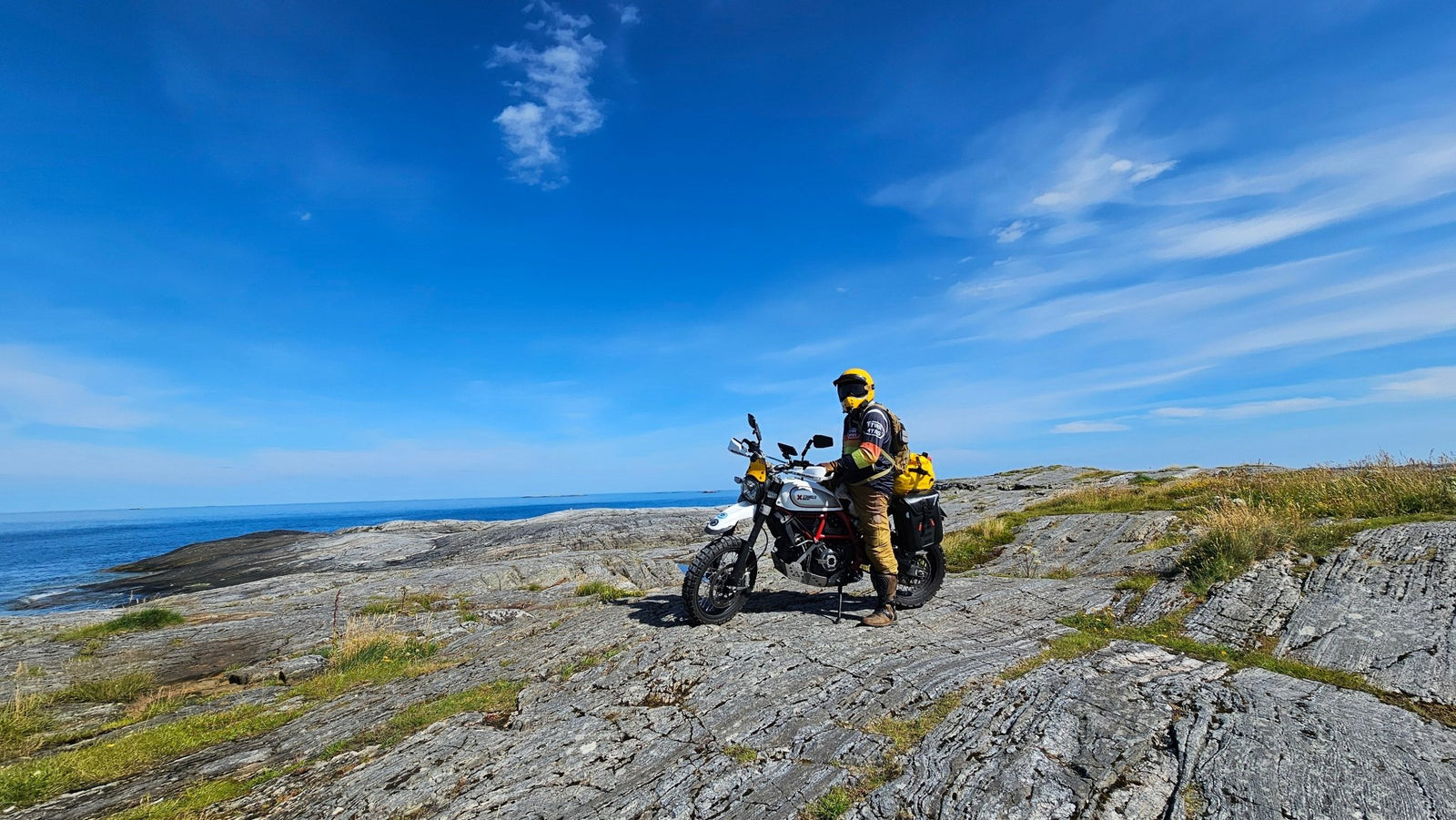
Last updated: July 2026
Norway is one of those places that makes a motorcycle feel like the only sensible way to travel. Fjords, mountain passes, coastal roads, ferries and tunnels turn even a simple route into a proper journey.
But Norway also rewards riders who arrive prepared. Speed limits are low and strictly enforced, the alcohol limit is almost zero, weather can change within minutes and ferry timetables often decide how far you actually get in a day.
This 2026 guide covers the traffic rules, tolls, ferries and practical details you should know before riding a motorcycle through Norway.
Speed limits in Norway
Unless signs state otherwise, the general limits are:
- Urban areas: 50 km/h
- Outside urban areas: 80 km/h
Many towns and residential areas use 30 or 40 km/h limits. Larger roads may be posted at 70, 80 or 90 km/h, while selected expressways and motorways can carry 100 or 110 km/h limits.
The sign always wins. Limits can change frequently around villages, tunnels, junctions and roadworks.
Speed cameras and enforcement
Norway uses fixed cameras, section-speed controls and manual police checks. Section control measures your average speed between two camera points rather than only at one location.
Penalties are expensive, and serious speeding can lead to an immediate driving ban. Norway is not the place to calculate how much tolerance a camera might allow. Keep an eye on the signs and enjoy the view instead.
Alcohol limit: 0.2‰
The legal alcohol limit is 0.2‰. Drink-driving normally leads to loss of the driving licence and may result in a fine or imprisonment.
For a motorcycle trip, treat the limit as zero. Between changing weather, tunnels, animals and narrow roads, you need every bit of attention available.
Helmet, lights and riding equipment
Motorcycle helmets are compulsory for riders and passengers. Headlights must be used at all times.
Norwegian authorities also recommend complete motorcycle equipment, including suitable gloves and boots, protective clothing and back protection. Weatherproof gear is not optional in practice. Even during summer, a sunny valley can be followed by cold rain on the next pass.
Do motorcycles pay road tolls?
Motorcycles and mopeds are normally exempt from Norway’s automatic road toll stations. You do not need an AutoPASS tag for ordinary motorcycle toll-road travel.
This exemption applies to the automatic road-toll network, including urban toll rings. Special private roads or separate transport services can have their own charges, so check locally when a route is not part of the standard road system.
Ferries are separate from road tolls
Road-toll exemption does not mean every ferry is free. Norway’s ferry network uses different operators and payment systems, and motorcycles have their own fare category.
Some connections are free, while others charge a motorcycle fare. AutoPASS for ferry covers most participating routes and can provide discounts through a registered agreement, but it is not essential for a short motorcycle trip.
Always check the individual crossing before departure. Summer 2026 rates apply on certain routes, and popular ferries can develop long queues in July.
Using Norwegian ferries with a motorcycle
- Arrive early on popular coastal routes.
- Follow crew instructions for parking and securing the bike.
- Leave the motorcycle in gear.
- Carry a simple strap if you are taking larger or rougher crossings.
- Do not plan an entire day around the final possible ferry.
On routes such as the Helgeland coast, ferry timing is part of the ride rather than an interruption to it.
Tunnels
Norway has thousands of tunnels, including very long subsea and mountain tunnels. Conditions can change immediately at the entrance: bright sunlight becomes darkness, the road may be damp and the temperature can drop sharply.
- Remove or open a dark visor before entering.
- Increase your distance from the vehicle ahead.
- Expect wind pressure near tunnel portals.
- Watch for condensation on the visor.
- Do not stop except in an emergency or designated bay.
Some tunnels include roundabouts, steep gradients or long descents. Do not underestimate how tiring repeated tunnel riding can become.
Right-of-way rules
Unless you are on a signed priority road, traffic from the right generally has priority. Vehicles must also give way to pedestrians at zebra crossings.
On roads with a speed limit of 60 km/h or lower, drivers must give way when a bus signals that it intends to leave a bus stop.
Narrow roads and blind corners
Many of Norway’s best motorcycle roads are narrow and have no centre line. Stay well to the right and expect motorhomes, buses, tractors, cyclists and sheep around blind bends.
Passing places are not parking spots. Use them to let traffic through and avoid forcing a larger vehicle into an impossible manoeuvre.
Weather and seasonal closures
Norwegian weather can move faster than your route plan. Mountain roads may remain closed well into spring and can close temporarily even during the riding season because of snow, landslides or severe weather.
Check official traffic information before starting the day, particularly when your route depends on a mountain pass or ferry. Several Norwegian Scenic Routes close during winter and reopen only when conditions allow.
Road surfaces
Main roads are generally very good, but frost damage, gravel, construction work and wet wooden bridge sections can appear with little warning. Roadworks may use loose stone before the final asphalt layer is applied.
Be especially careful after winter, near tunnel entrances and on smaller mountain roads where meltwater crosses the surface.
Animals on the road
Moose, deer, reindeer, sheep and other animals are common hazards. Reindeer can stand directly on the roadway in northern Norway and may move unpredictably when approached.
Slow down at wildlife warning signs and around dawn and dusk. If you hit an animal, stop safely, secure the scene and contact the authorities. Do not follow an injured animal into the terrain.
Fuel and distance planning
Fuel is widely available along major routes, but stations become less frequent in remote coastal and northern areas. Many rural stations are automated and may require a card with a PIN.
Fill up earlier than you would at home. A closed ferry, road diversion or missed fuel stop can add a significant distance in Norway.
Parking
Check signs carefully. Parking on priority roads is generally prohibited where the posted speed limit is 60 km/h or higher.
Do not block narrow passing places, access roads or ferry staging lanes. In towns, motorcycles may still need to follow the same payment and time restrictions as other vehicles unless a sign states otherwise.
Documents to carry
- Valid motorcycle driving licence
- Vehicle registration document
- Proof of motor insurance
- Passport or accepted national identity document
- European Accident Statement
Make sure your licence category matches the motorcycle and that your insurance covers Norway.
Camping and access to nature
Norway’s right to roam allows responsible access to uncultivated land, but it does not allow motorcycles to leave permitted roads and tracks.
When camping, keep a respectful distance from homes, avoid cultivated land, follow fire restrictions and leave the place exactly as you found it. Protected areas may have additional local rules.
Norwegian Scenic Routes
Norway has 18 official Scenic Routes. They are designed around the journey itself, with viewpoints, architecture and dramatic landscapes along the way.
Strong motorcycle options include:
- Ryfylke: fjords, mountains and technical sections
- Hardangervidda: exposed plateau riding and waterfalls
- Aurlandsfjellet: high mountain scenery and the Stegastein viewpoint
- Atlantic Road: bridges, islands and open ocean
- Helgelandskysten: coastal roads and multiple ferries
- Senja: sharp mountains and northern coastal scenery
- Varanger: remote Arctic landscapes and huge horizons
Some routes are narrow, busy in summer or seasonally closed. Build spare time into the plan rather than turning every viewpoint into a schedule problem.
Final thoughts
Norway is expensive, slow and occasionally inconvenient. That is also exactly why it remains special.
Respect the speed limits, ride completely sober, check ferries and road conditions each morning and never underestimate the weather. The reward is a country where tunnels open onto fjords, ferries become part of the route and a 250-kilometre day can feel like a full expedition.
Make it count.
Keep planning the ride
Continue with the complete motorcycle travel guide to Europe, or compare the rules in Sweden, Finland and Denmark.
Preparing the bike and yourself? Browse our motorcycle riding gear or discover the full RTWR MTRS collection.